How to Make Curtains Look Custom Without Buying Custom Curtains
Ready-made curtains can look custom when the rod placement, panel width, length, header, fabric, and hardware all work together. If one of those pieces is wrong, decorative trim or tiebacks will not fix the cheap-looking result.
Use this order before buying anything new: check the rod height, check how far the rod extends past the window, confirm the finished length, calculate the total panel width across the full rod span, choose a header that creates neat folds, then upgrade fabric or hardware. That sequence keeps you from spending money on details before the curtain structure is right.
The goal is a custom look, not a false promise that every ready-made panel can replace true made-to-fit curtains. Standard panels work well when your window can use common lengths and widths. Custom curtains are the cleaner shortcut when you need exact floor clearance, special sizing, built-in fullness, specific lining, or a precise header.
Start With the Real Problem: Height, Width, Length, Fullness, or Fabric

Most curtains that look store-bought have one dominant issue, and fixing that issue changes the room more than adding small decorative details.
Use this quick diagnosis:
| What looks wrong | Likely cause | First fix to test |
|---|---|---|
| The window looks short or squat | Rod is mounted too low | Raise the rod if the panel length allows it |
| The panels block too much glass when open | Rod is too narrow | Extend the rod farther past the trim |
| The curtains look skimpy when closed | Total panel width is too narrow | Add wider panels or more panels |
| The bottom looks accidental | Length is slightly off | Hem, adjust rings, or choose a clearer floor finish |
| The top looks casual or messy | Header style is not tailored | Use clips, hooks, back tabs, or pleated curtains |
| The fabric looks flat in the room | Color, opacity, or texture is wrong | Order swatches before replacing every panel |
| The whole setup looks temporary | Hardware is thin or mismatched | Upgrade rods, rings, brackets, or finials |
NICETOWN's measurement guide gives the most useful starting numbers for this diagnosis: plan rod height before measuring length, measure the pole span accurately, extend coverage beyond the window frame, and choose fullness based on the top style and desired look.
Hang the Rod Like You Planned the Wall, Not Just the Window

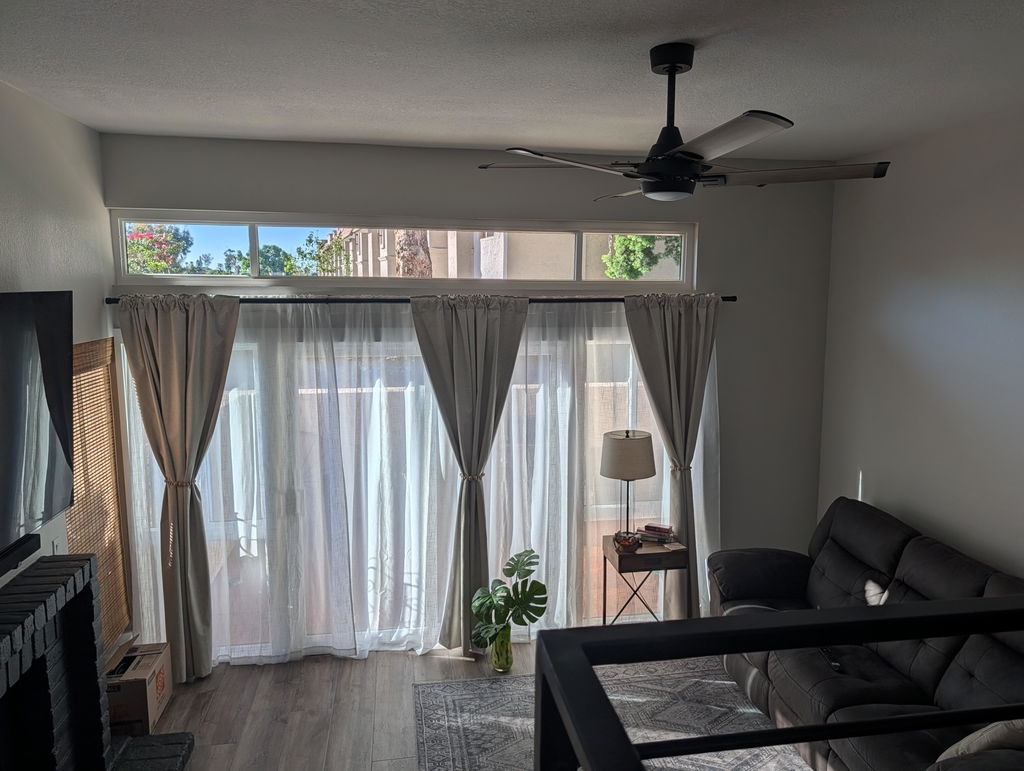
The rod controls the visual size of the window. A low, narrow rod makes curtains look like an afterthought attached to the trim. A higher, wider rod makes the fabric read as part of the room architecture.
For many outside-mount curtain setups, place the rod several inches above the window frame and extend it beyond both sides of the trim. NICETOWN's measurement guide recommends installing a curtain rod 6 to 10 inches above the window frame and planning 6 to 15 inches of extra width on each side when the rod is not already installed. Those ranges are useful because they account for both appearance and coverage.
Do not raise the rod first and measure later. Raise the rod only if your curtains can still reach the intended finish at the floor. A panel that is too short after remounting will look less custom than a lower rod with a clean floor kiss.
Wider rod placement solves two problems at once. Open curtains can stack outside the glass instead of covering daylight, and closed curtains can overlap the window edges enough to reduce side gaps. That matters more in bedrooms, media rooms, and street-facing rooms where light control or privacy is part of the purchase decision.
If your current rod is sturdy, level, and close to the right height, you may not need to drill new holes. In a rental or a room with fragile plaster, extra panel width and better headers may deliver most of the visual upgrade without moving hardware.
For a full installation decision, use NICETOWN's curtain rod resources: the curtain rod height guide for placement and curtain rods when the current hardware looks too thin for the panels.
Buy Enough Fabric for the Full Rod Span

Curtain fullness should be calculated from the full rod span, not only from the window glass. A 72-inch-wide window on a 96-inch rod needs fabric for the 96-inch span if the panels are expected to close and still look full.
Use this simple decision rule:
| Desired look | Total fabric width target | Best use |
|---|---|---|
| Clean and controlled | About 1.5x the rod span | Small rooms, simple designs, tighter budgets |
| Fuller and more custom-looking | About 2x the rod span | Living rooms, bedrooms, wide windows, decorative drapes |
| Very soft or sheer | Often more than 2x, depending on fabric | Sheers and lightweight fabrics that look thin when stretched |
The top style changes the math. NICETOWN's measurement guide notes that some pleated styles already build fullness into the finished curtain, while grommet, back-tab, and rod-pocket styles require you to choose enough width for the folds you want. That means two panels with the same listed width can look very different once hung.
If your curtains only frame the window and never close, you can prioritize stack and appearance on each side. If your curtains need to close every night, calculate enough fabric to cover the whole rod span with fullness left over. Panels that barely meet in the middle will look strained and will also leave more opportunity for light and privacy gaps.
Adding a second panel on each side can work when the fabric is not too bulky and matching panels are available. It can fail when the rod sags, the rings crowd, or the extra fabric creates a heavy stack that blocks too much glass. If the panel count feels excessive, compare the cost of more ready-made curtains against made-to-fit panels before buying duplicates.
Choose the Right Length Finish Before You Commit

Curtain length looks custom when the bottom edge has a deliberate relationship to the floor. It looks accidental when it floats above the floor by a few inches, drags unevenly, or puddles in a room where people walk through the fabric.
Use these finishes:
| Length finish | What it means | Best use | Risk |
|---|---|---|---|
| Floor kiss | The curtain just meets or nearly meets the floor | Most bedrooms, living rooms, dining rooms | Requires accurate measuring |
| Slight break | The curtain has a small relaxed bend at the floor | Softer casual rooms and imperfect floors | Can look sloppy if uneven |
| Puddle | Extra fabric rests on the floor | Low-traffic formal spaces | Collects dust and needs more arranging |
| Sill or apron length | Curtain ends at or below the sill | Kitchens, bathrooms, cafe curtains, furniture-blocked windows | Can look too casual in main rooms |
The Home Depot's curtain measuring guide describes puddled drapes as a style that can collect dust and dirt and is better suited to low-traffic areas such as formal dining rooms and guest bedrooms. That is the practical limit many short "make curtains look expensive" lists skip.
If your ready-made panels are slightly too long, hemming usually looks better than letting everyday curtains puddle by accident. If they are slightly too short, try ring clips or hooks only if the adjustment gets the bottom to a clear finish. Do not raise a too-short panel higher just because high rods are trending.
NICETOWN's curtain length guide is the better next read when the main question is whether your room needs floor, sill, apron, or cafe length.
Make the Header Look Tailored
The header is the top construction of the curtain, and it heavily affects whether ready-made panels look casual or tailored. The same fabric can look basic on a rod pocket and more polished on rings, hooks, back tabs, or pleats.
| Header option | Custom-look potential | Operation | Watchout |
|---|---|---|---|
| Rod pocket | Low to moderate | Often harder to slide | Can bunch tightly and look static |
| Grommet | Moderate, more casual | Easy to slide | Metal circles create a visible rhythm that may not feel tailored |
| Back tab | Moderate to high | Cleaner front view | Needs enough width to create folds |
| Clip rings | High when clipped into small folds | Easy to adjust | Can show clips and may allow light at the top |
| Pleating hooks or tape | High | More structured | Requires compatible panels and careful spacing |
| Made-to-fit pleated headers | Highest control | Designed for the chosen rod or track | Usually belongs in the custom category |
Clip rings are popular because they can create a faux pleat without sewing. The better method is not to clip the flat top edge at random intervals. Pinch a small fold of fabric at each clip so the panel falls in repeated vertical folds. NICETOWN's cafe curtain article uses the same principle for a more tailored look: hardware and header style decide whether a simple panel reads as intentional or DIY.
Clip rings are not the right answer for every room. In a blackout bedroom, clips can leave small light gaps above the panel unless the rod, rings, and panel height are planned carefully. A back-tab, pleated, or custom blackout curtain may be the better choice when the room needs darkness more than decorative flexibility.
Steam, Train, and Weight the Panels After Hanging
Wrinkles and random folds can make good panels look cheaper than they are. Finish the curtains after installation instead of judging them straight from the package.
Use this post-hang sequence:
- Steam or iron according to the fabric care instructions.
- Arrange the folds by hand from the header to the hem.
- Temporarily hold the folds with soft ties or clips.
- Let the fabric hang in that position.
- Remove the ties and check whether the folds return naturally.
- Reassess fullness, length, and weight only after the fabric relaxes.
Training works best when the panel already has enough width. A narrow panel cannot form generous folds because the fabric is being pulled flat. Heavy or lined panels may also need stronger rings and rods before the folds hang cleanly.
Hem weights can help the lower corners fall straighter, but they should not be used to hide major length or width mistakes. If the fabric twists, flares, or bows because the header is crowded, fix spacing and rod support first.
Upgrade Hardware Before Decorative Trim
Hardware is usually a better upgrade than trim because the rod and rings affect both appearance and operation. A thin rod, weak brackets, mismatched rings, or crowded finials can make expensive-looking fabric feel temporary.
Prioritize hardware in this order:
- Rod strength: the rod should not bow under the full fabric weight.
- Rod length: the span should let panels stack beyond the glass where possible.
- Ring or hook compatibility: the header should move cleanly without tugging.
- Finish consistency: rods, rings, brackets, and finials should look intentional together.
- Finial scale: end caps should suit the wall and window size without stealing attention.
Decorative trim, border tape, and tiebacks work best after the dimensions are correct. A contrast border on the leading edge can make plain panels look more designed, but it will also draw attention to crooked hems, uneven folds, and poor length. If the fabric color or texture is the weak point, order curtain swatches before replacing all the panels.
Tiebacks should solve a room problem, not just add decoration. Use them when you need panels held clear of a door, radiator, desk, or reading chair. Skip them when the curtain already stacks neatly and the extra detail makes the window feel busy.
Do Not Confuse a Custom Look With Custom Performance
Styling can make curtains look more custom, but fabric and installation determine much of the performance. A higher rod, wider span, and fuller panels can reduce visible gaps, but they do not turn a decorative panel into a tested blackout, thermal, privacy, or sound-reducing product.
The U. S. Department of Energy explains that drapery performance depends on factors such as fabric type, color, installation, season, climate, and use. It also notes that window coverings can affect privacy, glare, comfort, heat gain, and heat loss. That means curtain performance is a system: the panel, window, mounting position, closure habits, and room exposure all matter.
Use this distinction when choosing products:
| Need | Styling can help by | Product choice still matters because |
|---|---|---|
| Blackout | Reducing side and center gaps | Fabric opacity, lining, header, and top gaps control light leakage |
| Privacy | Increasing coverage and fullness | Sheer and light-filtering fabrics behave differently at night |
| Thermal comfort | Covering more of the window and reducing drafts near edges | Fabric, lining, installation tightness, season, and window exposure affect results |
| Noise reduction | Adding fabric mass and coverage | Ordinary decorative panels should not be treated as soundproof curtains |
| Design polish | Improving proportions and folds | Color, texture, header, and hardware still need to match the room |
NICETOWN separates these buying paths into product categories, which is useful when performance matters: blackout curtains, privacy curtains, soundproof curtains, and thermal-insulated curtains.
When Ready-Made Is Enough, and When Custom Is the Better Shortcut
Ready-made curtains are enough when the available width and length can create the right rod placement, floor finish, and fullness. They are also the practical choice for rentals, budget-sensitive rooms, seasonal refreshes, and spaces where the curtains mainly frame the window.
Choose ready-made curtains when these conditions are true:
- A standard length reaches the floor from your planned rod height.
- The window can be covered with available panel widths.
- The header style works with your rod or rings.
- You can get enough fullness without overcrowding the rod.
- You do not need exact matching across several unusual windows.
- Decorative appearance matters more than precise performance.
Custom curtains become the better shortcut when workarounds start stacking on top of each other. If you need to raise the rod, hem every panel, add extra panels, change the header, add lining, and still solve light gaps, the ready-made route may no longer be the simpler one.
Choose custom curtains when these conditions are true:
- The window needs a non-standard length or width.
- Multiple windows must match exactly across one room.
- You need a specific pleated, goblet, flat hook, or track-compatible header.
- Blackout, privacy, thermal comfort, or noise reduction is a major goal.
- The room is highly visible, such as a living room, primary bedroom, or street-facing front room.
- The existing window shape makes standard panels look patched together.
This is the main custom-look rule: use ready-made panels when standard sizes can create the correct proportions; use custom curtains when exact fit is the fastest way to remove compromises.
Quick Room-by-Room Rules
Different rooms expose different curtain mistakes. A living room may need fullness and texture most, while a bedroom may need gap control more than decorative trim.
| Room | Prioritize | Avoid |
|---|---|---|
| Bedroom | Blackout or privacy fabric, side overlap, center overlap, controlled top gaps | Clip-ring setups that leak light if darkness is the main goal |
| Living room | High and wide rod placement, 2x-looking fullness, better texture, coordinated hardware | Panels that only cover the glass and make the wall look smaller |
| Dining room | Clean floor kiss or slight break, refined header, fabric weight | Dramatic puddles in a space where chairs catch the fabric |
| Kitchen | Sill, apron, or cafe length, washable practicality, simple rods | Floor-length fabric near work zones or heat sources |
| Nursery or child's room | Cordless or safer window-covering choices, secure hardware, practical blackout | Dangling cords or hardware that invites pulling |
| Rental | Existing holes when usable, clip rings, extra fullness, tension-free changes | Drilling new holes before testing panel length and stack |
The U. S. Consumer Product Safety Commission recommends cordless window coverings where young children are present because corded window coverings can create a strangulation hazard. If a room is used by young children, safety should outrank the custom-looking detail.
FAQ
Can cheap curtains really look custom?
Cheap curtains can look more custom when they are wide enough, long enough, steamed, hung on better hardware, and styled with a tailored header. They will still look cheap if the fabric is too shiny, too thin, too short, or too narrow for the rod span.
What makes curtains look expensive first?
Correct proportions make the biggest first impression. Raise and widen the rod if the panel length allows it, then add enough total fabric width for folds across the full rod span.
Are clip rings better than grommets?
Clip rings usually look more tailored than grommets when the fabric is pinched into even folds. Grommets are easier and casual, but their metal openings create a more obvious ready-made look.
Should curtains touch the floor?
Most full-length curtains in bedrooms, living rooms, and dining rooms should kiss the floor or have a slight break. Sill and apron lengths make more sense for kitchens, cafe curtains, bathrooms, and windows blocked by furniture.
How do I know if I should buy custom curtains instead?
Buy custom when standard panels force too many compromises: wrong length, insufficient width, poor header choice, light gaps, unmatched windows, or performance needs that styling cannot solve.
Conclusion: Fix the Structure Before the Styling
The fastest way to make curtains look custom is to correct the visible structure: rod height, rod width, panel length, fullness, header, and hardware. Trim, tiebacks, and styling details should come after those choices are right.
Start with NICETOWN's measurement guide, compare standard options in ready-made curtains, and move to custom curtains when exact fit or performance matters more than working around standard panel sizes.
Before You Go…
Here are a few handpicked articles to inspire your next self-care moment.